Momentum around AI continues to build and is reshaping how healthcare brands connect with healthcare professionals and patients. In an earlier blog, we outlined how we believe successful brands should invest wisely in robust, ethical, human-guided AI capabilities that are built to last. However, one criticism of unmitigated growth in AI use is that it poses significant ethical, climate and environmental risks.
In our latest blog, Digital Director Craig Lambert shares his perspective on responsible AI usage, and how smarter AI prompts do not just lead to more intelligent outputs but can benefit the environment too.
We talk to AI like it's limitless… a tireless assistant for casual back-and-forth conversations. Yet every "can you just" prompt carries a hidden cost: electricity, water, resource. This isn't digital magic, it's actually warehouses full of servers. The technology is exciting, but how we engage with it demands thought and scrutiny.
When I fire off a prompt from the IGNIFI office in Sunderland (normally coffee-fuelled and dangerously close to Greggs), that thinking whirs away in data centres based in the USA, where a total of 183 TWh (4% of their national grid) was consumed in 2024. AI workloads alone consumed 53-76 TWh, which is enough to power 7.2 million homes. Just think about that for a second.
Closer to home, UK centres guzzle 1-2% of our own electricity today (~2.3-4.6 TWh), but the National Energy System Operator forecasts they'll hit 10% by 2050 as AI demand surges. A single ChatGPT query uses around 0.5 litres of water (that’s 10x more than a Google search). Overly chatty habits don't just annoy your mates; they make the planet thirsty.
AI runs on warehouses of servers, not the clouds of imagination. Globally, Goldman Sachs says power needs will jump 165% by 2030 because of AI. Water usage is even worse, U.S. centres gulped 17 billion gallons in 2023 alone, that’s 77 billion litres for us brits, which is enough to fill Wembley Stadium 19 times over.

These aren't abstract numbers, they're the cost for our "quick, clarify that" culture. In healthcare marketing, where precision already rules, casual AI use in strategy sessions makes the problem ten times worse. We've got enough real regulations without accidentally taxing the national grid too.
Chat interfaces make iteration feel effortless, almost human. "Suggest campaign themes." "Digital-first." "Add patient focus." Each response is recomputed from scratch. The servers don't pause for a cuppa, they hum at peak, cooled by endless water loops.
It's the conversational trap. We treat AI like a mate down the pub, when it's really a precision engine disguised as a chatbot. In regulated sectors like healthcare, this can risk diluting focus, any early compliance cues can vanish in the back-and-forth fog.
Planning a month's social media content for brand awareness (any industry). Let's try using AI two different ways: chatty vs strategic:
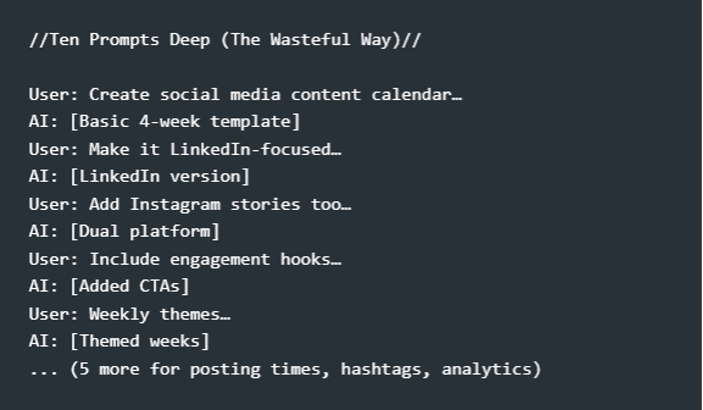
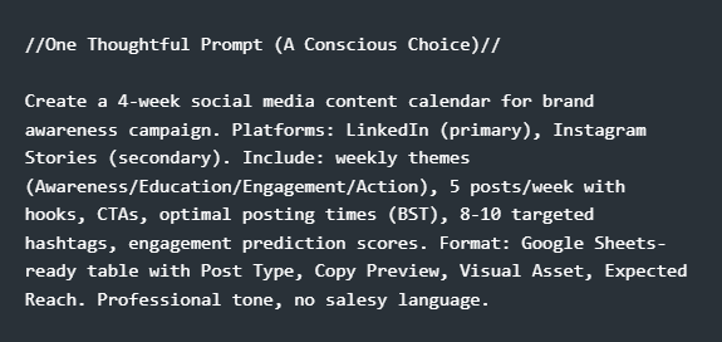
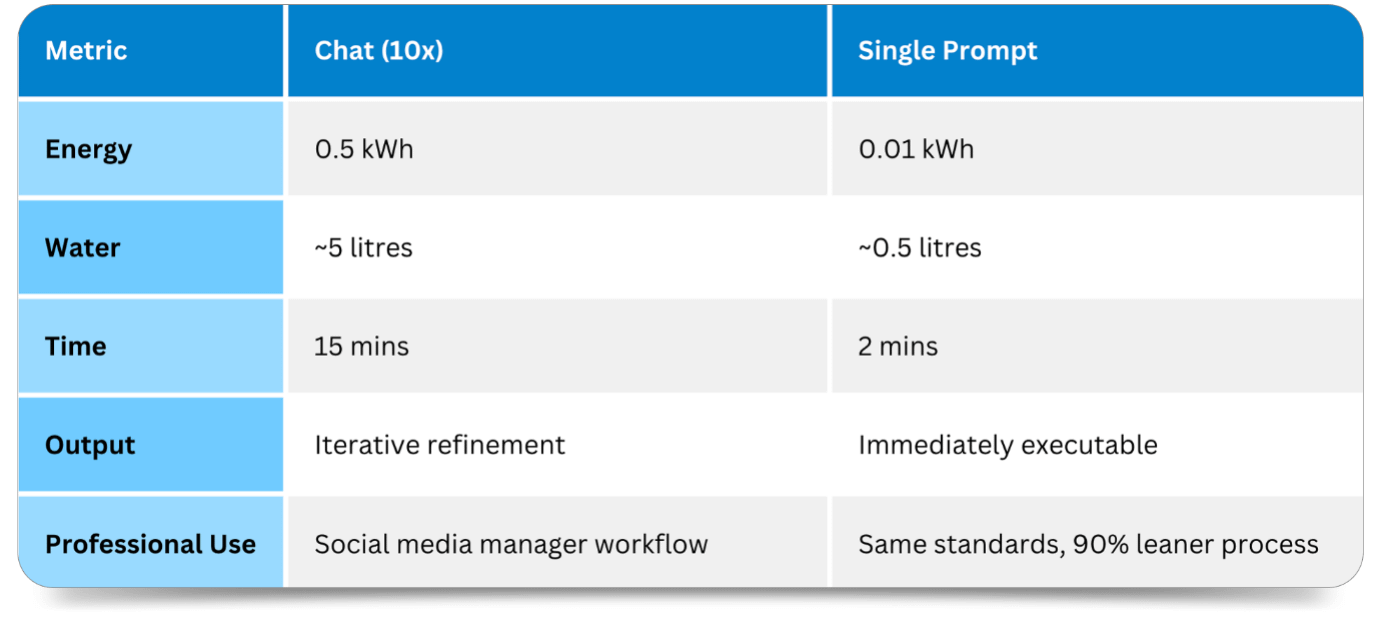
At IGNIFI we use AI surgically, one deliberate ask beats ten daft ones. It's not rocket science; it's basic manners for the machines keeping our new digital world spinning.
Healthcare marketing demands precision. AI's great for audience patterns and channel plans. Medical writers? They live the science and ABPI code. I’ve seen this play out at IGNIFI: AI can power our Creative Studio with image tweaks, voiceovers and fiddly code fixes, but our medical writers own every word of science, the claims and ABPI compliance. Humans handle the nuances that matter.
The answer? Precision prompting. One intentional ask for content calendars or HCP segmentation beats endless refinement. It saves resources and sets the standard for teams. In today's carbon-counting world, this isn't just efficiency, it's leadership that actually plans ahead.
Little shifts can make a big difference:
At IGNIFI we batch related tasks into single, meaty prompts
Build reusable templates for recurring faff (campaign briefs, audience personas)
Use AI for polishing strategy, not 'how many teaspoons in a pint?'
It turns out, better prompts make you a sharper thinker. Tech teaching us to think, who on earth saw that coming?
AI could claim half of the projected 426 TWh U.S. data centre demand by 2030 and while greener servers will help, user behaviour sets the pace. We're not helpless, we're the ones currently handing servers the reins.
ChatGPT isn't a chatroom, it's an engine. The real intelligence lives in how we prompt. In high-stakes fields like healthcare marketing, precision isn't optional, it's how you lead when the planet's watching.


© IGNIFI 2026
IGNIFI Limited Registered office: 40 George Street, London, W1U 7DW
Company number: 2128733
Registered VAT number: 357 1506 56